Sales - New: 1 844 484-6105
Sales - Used: 1 844 484-6105
Service & Parts: 450-431-3550


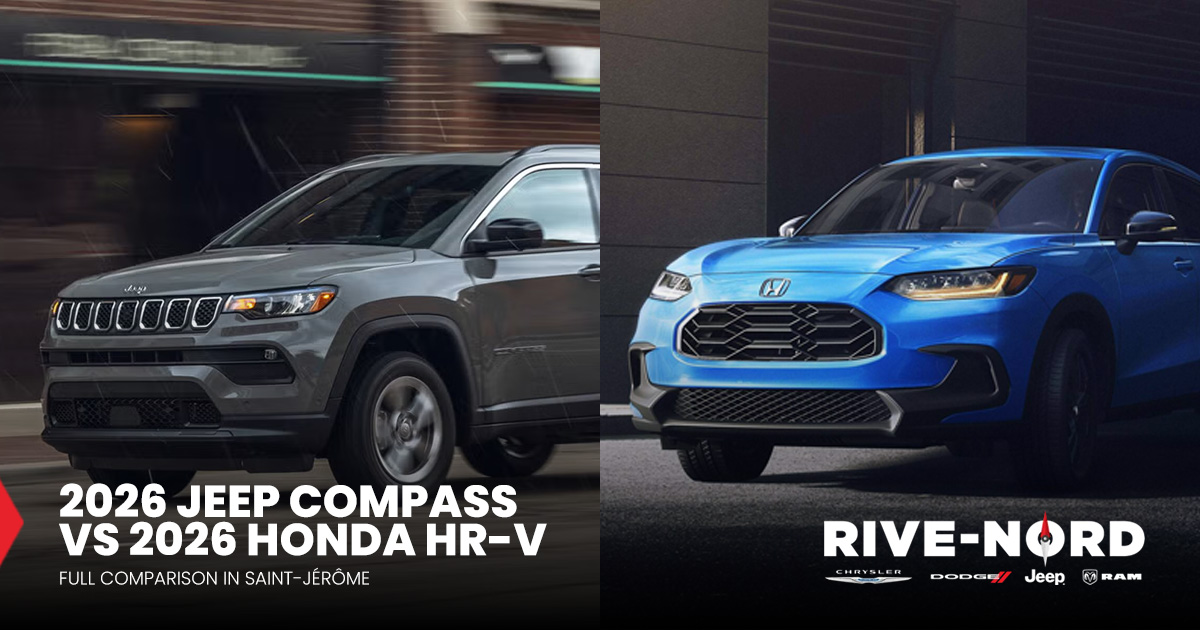
The compact and subcompact SUV market is particularly competitive in Quebec. For drivers in Saint-Jérôme, Mirabel, Prévost, Sainte-Sophie and the Laurentians, two models can quickly end up on the same shopping list: the 2026 Jeep Compass and the 2026 Honda HR-V. Both seat five occupants, offer a format compact enough for everyday driving and provide solutions suited to winter conditions. Their approaches, however, are quite different.
The Honda HR-V focuses primarily on efficiency, mechanical simplicity and a versatile cabin. The Jeep Compass adopts a more rugged personality with a significantly more powerful turbocharged engine, standard 4×4, an eight-speed automatic transmission and towing capability that considerably broadens its possibilities.
For a driver who has to deal with Laurentian snow, Highway 15, secondary roads and weekend getaways, these differences deserve a closer look. Here is our comparison of the 2026 Jeep Compass vs 2026 Honda HR-V.
| Feature | 2026 Jeep Compass | 2026 Honda HR-V |
| Engine | 2.0 L turbocharged 4-cylinder | 2.0 L 4-cylinder |
| Horsepower | 200 hp | 158 hp |
| Torque | 221 lb-ft | 138 lb-ft |
| Transmission | 8-speed automatic | CVT |
| Drivetrain | Standard 4×4 | FWD or available Real Time AWD depending on trim |
| Combined fuel economy | 8.9 L/100 km | 8.3 L/100 km FWD; 8.7 L/100 km AWD |
| City/highway fuel economy | 10.0 / 7.5 L/100 km | 9.1 / 7.4 L/100 km FWD; 9.5 / 7.8 L/100 km AWD |
| Maximum towing capacity | 907 kg (2,000 lb), when properly equipped | Not rated for towing |
| Maximum cargo volume | Up to 1,693 L | 1,559 L |
| Seating capacity | 5 | 5 |
| Ground clearance | 205 mm; up to 218 mm Trailhawk | 177.8 to 185.4 mm depending on trim |
| Infotainment display | 8.4-in. Uconnect 5; 10.1-in. available | 9-in. centre display |
| Digital display | Up to 10.25 in. | 7-in. TFT display |
The Compass figures come from technical information published by Jeep Canada, while the HR-V figures are taken from Honda’s official Canadian documentation for the 2026 model year.

The biggest difference between the two SUVs appears under the hood. The 2026 Jeep Compass uses a 2.0-litre turbocharged four-cylinder engine producing 200 horsepower and 221 lb-ft of torque. It is paired with a true eight-speed automatic transmission and standard 4×4.
The 2026 Honda HR-V, meanwhile, uses a naturally aspirated 2.0-litre four-cylinder producing 158 horsepower and 138 lb-ft of torque, paired with a continuously variable transmission, or CVT. The LX can be ordered with front-wheel drive or Real Time AWD, while Sport and EX-L trims are offered with all-wheel drive in Canada.
That gives the Compass an advantage of 42 horsepower and 83 lb-ft of torque. In everyday use, this additional reserve becomes especially relevant when the vehicle is carrying several passengers and their luggage, when merging onto the highway, passing on a regional road or climbing hilly roads in the Laurentians.
The transmission also helps distinguish how the two vehicles behave. The HR-V’s CVT prioritizes smooth acceleration and efficient engine operation. The Compass instead retains the feel of a conventional eight-speed automatic. For drivers who appreciate a more traditional mechanical response, this configuration represents an important difference.
Winter traction is particularly important when shopping for an SUV in Saint-Jérôme. From November through spring, road surfaces can quickly go from dry to snow-covered or icy, and conditions often become more demanding as you travel toward Prévost, Saint-Sauveur and the northern Laurentians.
The 2026 Jeep Compass comes standard with 4×4, along with the Selec-Terrain traction management system. Jeep Active Drive can automatically distribute power when conditions require it. The Compass also offers 205 mm of ground clearance on regular 4×4 models and up to 218 mm on the Trailhawk.
The HR-V, meanwhile, offers Real Time AWD with Intelligent Control. It is designed to transfer power to improve traction when wheel slip is detected. Honda also offers Normal, ECON and Snow drive modes. Ground clearance is 177.8 mm on certain LX configurations and approximately 185.4 mm on Sport and EX-L trims.
Both can therefore be configured to handle Quebec winters, but their philosophies differ. The HR-V remains primarily road-oriented, while the Compass adds greater ground clearance and standard 4×4. For cottage owners, outdoor enthusiasts or drivers who regularly travel on less thoroughly cleared roads, these characteristics can be particularly important.
The HR-V has a slight advantage when fuel consumption alone is considered. With front-wheel drive, Honda lists 8.3 L/100 km combined. With Real Time AWD, the rating increases to 8.7 L/100 km, with figures of 9.5 L/100 km in the city and 7.8 L/100 km on the highway.
Jeep lists combined fuel consumption of 8.9 L/100 km for the 2026 Compass. Technical specifications indicate approximately 10.0 L/100 km in the city and 7.5 L/100 km on the highway.
For a fair comparison between two all-wheel-drive vehicles, the difference between the HR-V AWD and Compass is therefore only about 0.2 L/100 km in combined fuel consumption, despite the Jeep’s additional 42 horsepower and 83 lb-ft.
A primarily urban driver who chooses a front-wheel-drive HR-V can reduce fuel consumption further. On the other hand, a buyer who wants standard four-wheel drive, greater power and towing capability gets a very different package with the Compass for combined fuel consumption that remains close to that of the HR-V AWD.
A compact SUV needs to remain practical. On this point, both models have a 60/40-split folding rear seat that makes it easier to carry larger items.
Honda lists 691 litres behind the rear seat and up to 1,559 litres with it folded. This configuration makes the HR-V particularly practical for groceries, luggage and the needs of a small family.
Jeep lists up to 1,693 litres of cargo space with the rear seats folded for the Compass. It therefore offers greater maximum cargo volume despite a shorter body: the Compass measures approximately 4.40 metres long, compared with approximately 4.57 metres for the HR-V.
The difference becomes much greater when it is time to tow a trailer. When properly equipped, the 2026 Jeep Compass can tow up to 907 kg, or 2,000 lb. Jeep also indicates in its Canadian comparison that the 2026 HR-V is not rated for towing.
For transporting bikes, outdoor equipment or simply a lot of luggage on a trip to the Laurentians, both vehicles remain versatile. When a small trailer is added, however, the Compass opens up possibilities the HR-V does not offer.

Inside the 2026 Jeep Compass, Uconnect 5 is at the centre of the digital experience. The Sport model receives an 8.4-inch touchscreen, while a 10.1-inch display is offered on several higher trims. A 10.25-inch digital driver display is also available. Apple CarPlay and Android Auto are part of the connectivity ecosystem.
The 2026 HR-V uses a 9-inch centre display, accompanied by a 7-inch TFT instrument display. Honda documentation also lists Apple CarPlay and Android Auto with wired or wireless operation, as well as a wireless phone charger.
Honda therefore offers a simple and cohesive interface. Jeep, meanwhile, provides more display area when the Compass is equipped with the 10.1-inch Uconnect 5 system and 10.25-inch digital cluster. For those who regularly use navigation, music and smartphone apps, both offer the essentials expected from a 2026 SUV.
Honda equips the HR-V with the Honda Sensing suite, which notably includes Adaptive Cruise Control, the Collision Mitigation Braking System, Lane Departure Warning, Lane Keeping Assist, Road Departure Mitigation and Traffic Sign Recognition.
The Compass notably comes standard with Forward Collision Warning with Active Braking. Depending on the trim and equipment, it can also offer Blind Spot Monitoring, Rear Cross Path Detection and Adaptive Cruise Control with Stop and Go. Jeep advertises more than 80 standard and available safety and security features.
It is important to consider the exact trim when comparing the two vehicles, since certain features may be standard on one model and optional on another.

The Compass’s size is well suited to the realities of a region like Saint-Jérôme. At approximately 4.40 metres long, it remains compact enough for parking and everyday driving while offering five seats, generous cargo space and standard four-wheel drive.
For a daily commute between Saint-Jérôme, Mirabel and the North Shore, the HR-V remains appealing thanks to its fuel economy and primarily road-focused behaviour. As soon as the vehicle’s use includes more snow, secondary roads, outdoor equipment, a small trailer or regular trips farther north in the Laurentians, the Compass’s additional capabilities become easier to take advantage of.
Rive-Nord Chrysler is located in the Lafontaine area of Saint-Jérôme and lets shoppers compare different versions of the model in person. You can browse the new Jeep Compass inventory in Saint-Jérôme as well as available Jeep Compass demonstrators before your visit.
The 2026 HR-V retains several convincing advantages. Its fuel consumption is slightly lower, particularly in its front-wheel-drive version, its cargo volume is generous and Honda Sensing brings together several driver-assistance technologies.
The Compass meets a different need and offers characteristics that can matter significantly in the Laurentians. Its 200 horsepower, 221 lb-ft of torque, eight-speed automatic transmission, standard 4×4 system, higher ground clearance, 1,693 litres of maximum cargo volume and 2,000-lb towing capacity give it greater versatility when use goes beyond urban driving.
To discover the model’s different configurations, a visit to Rive-Nord Chrysler can help determine which Compass version best matches your needs and budget. You can also complete an online auto financing application or contact Rive-Nord Chrysler to plan a test drive in Saint-Jérôme.
Yes. The Compass produces 200 horsepower and 221 lb-ft of torque from its 2.0-litre turbocharged engine. The HR-V produces 158 horsepower and 138 lb-ft with its naturally aspirated 2.0-litre engine. The Jeep therefore has an additional 42 horsepower and 83 lb-ft of torque.
The HR-V has the lowest combined fuel-consumption rating, at 8.3 L/100 km with front-wheel drive and 8.7 L/100 km with all-wheel drive. The Compass 4×4 is rated at 8.9 L/100 km combined. When comparing all-wheel-drive configurations, the official difference is therefore relatively small.
Yes. When properly equipped, the 2026 Jeep Compass has a maximum towing capacity of 907 kg or 2,000 lb. This capability can be especially useful for recreation and getaways in the Laurentians.
With the rear seats folded, Jeep lists up to 1,693 litres for the Compass, compared with 1,559 litres for the 2026 HR-V. The HR-V also offers 691 litres with the rear seats upright.
Yes. The 4×4 system is standard on the 2026 Jeep Compass in Canada and works with the Selec-Terrain traction management system. The Honda HR-V, meanwhile, offers front-wheel drive on the LX and Real Time AWD on certain configurations; Sport and EX-L trims are equipped with all-wheel drive in the 2026 Canadian documentation.

$99
Weekly for 96 months at 5.99%
with a down payment of $1,999
Retail price
$34,714
* Photo for illustrative purposes only. Certain conditions apply.
$99
Weekly for 96 months at 5.99%
with a down payment of $1,999
Retail price
$34,714
* Photo for illustrative purposes only. Certain conditions apply.